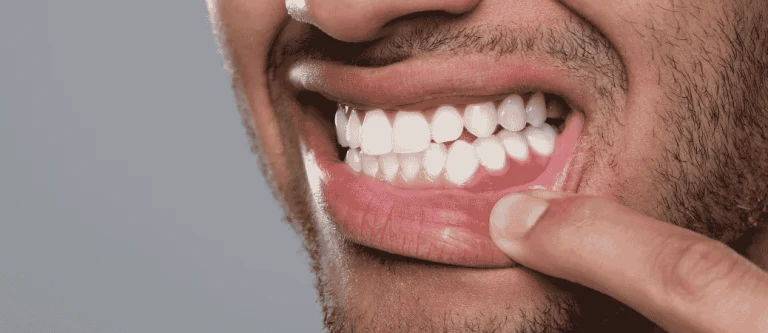
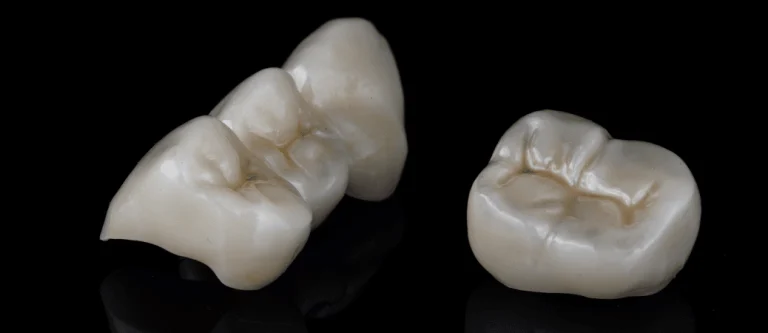
Hearing that a tooth needs to come out can feel scary. You might wonder if there was something you could have done differently, or if there is another way to fix the problem.
The truth is, dentists only recommend extraction when it is truly the best choice for your health.
A professional tooth extraction by an experienced dentist is usually recommended when the tooth is too damaged, decayed, or infected to be fixed by other treatments, or when it puts your other teeth at risk.
Your dentist will always try to save your natural teeth first, since keeping them is better for your long-term oral health.
This article walks you through when tooth extraction is necessary, what your dentist looks at before making that call, and what happens once the tooth is out.
You will also learn what the actual procedure looks like, how to care for your mouth afterward, and what your options are for replacing the missing tooth.
By the end, you should feel more confident about what to expect and why this choice supports your overall oral health.
Key Takeaways
- Sometimes removing a tooth is the healthiest choice, even though dentists prefer to save teeth whenever they can.
- Your dentist checks things like damage, infection, and bone health before recommending removal, and the same checkup can also confirm when a damaged tooth can still be saved.
- After the tooth is removed, proper healing and care, plus choosing a replacement, help protect your smile and health going forward.
Situations Where Removal May Be the Healthiest Choice
Your dentist will always try to save your natural tooth first. But sometimes, taking a tooth out is what protects your smile and your overall health in the long run.
Severe Decay That Cannot Support a Restoration
Cavities that go untreated can eat away at your tooth structure over time. When decay reaches deep into the tooth, it can destroy the enamel and leave very little healthy material behind.
If too much of your tooth is gone, a filling won’t have anything solid to attach to. In these cases, severe decay can make extraction the best option instead of trying to rebuild a tooth that won’t hold up.
Your dentist will check how much of the tooth is left before deciding. This helps you avoid future pain or a broken restoration down the road.
Advanced Gum Disease and Tooth Mobility
Gum disease starts small but can turn serious if it’s not treated early. Advanced periodontal disease, also called periodontitis, attacks the bone support around your teeth.
Once you lose enough bone, your tooth may start to feel loose. This happens because the surrounding bone can no longer hold the tooth in place.
You might notice your tooth shifting or feeling wobbly when you bite down. At this point, advanced gum disease can make a loose tooth impossible to save, and removing it protects the healthy teeth nearby.
Therefore, you might need a periodontics & gum disease treatment to ensure the health of your gums and the supporting structures around your teeth
Root Fractures and Irreparable Dental Trauma
A cracked tooth can sometimes be treated with a crown or bonding. But a vertical root fracture is a different story.
This type of fracture runs through the root itself, often below the gum line. It usually cannot be repaired because the crack splits the tooth from the inside out.
Dental trauma from an accident or injury can also cause damage that goes too deep to fix.
If your tooth is fractured in a way that a root canal or crown can’t repair, extraction may be your safest and most predictable choice.
Impacted Teeth and Orthodontic Space Needs
Sometimes a tooth needs to come out even if it isn’t decayed or damaged. Impacted wisdom teeth are a common example, since they often don’t have enough room to grow in correctly.
This can lead to pain, swelling, or pressure on nearby teeth. Overcrowding is another reason your dentist or orthodontist may recommend removal.
If your mouth doesn’t have enough space for all your teeth, taking one out can improve your bite alignment. This step is often part of a bigger orthodontic treatment plan to help your teeth line up properly.
Persistent Infection and Failed Previous Treatment
Sometimes a tooth has already been treated once, but the problem comes back. A dental infection that keeps returning after a root canal can be a sign that the tooth just can’t heal.
In these cases, another round of treatment may not solve the issue. If an infection keeps coming back after prior treatment, your dentist may suggest removing the tooth instead of trying the same approach again.
This helps stop the infection from spreading to nearby teeth or bone. It also gives you a clearer path toward lasting relief and a healthier mouth overall.
When a Damaged Tooth Can Still Be Saved
A damaged tooth is not always a lost cause. Depending on how much healthy structure remains and how healthy your gums and jawbone are, your dentist may be able to repair the tooth instead of pulling it.
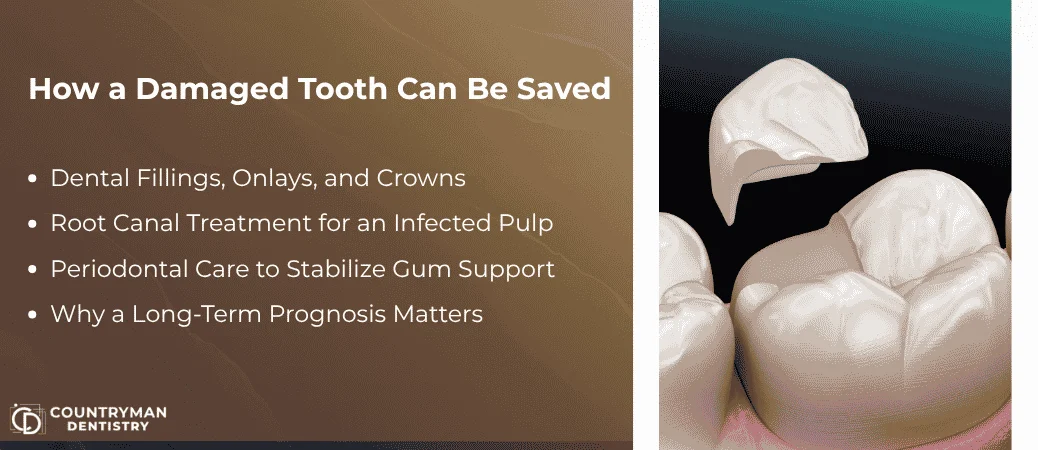
Dental Fillings, Onlays, and Crowns
If your tooth has a cavity or a small crack, a professional dental filling might be all you need. Fillings work well when the damage is limited, and most of your natural tooth is still intact.
For larger areas of damage, your dentist might suggest an onlay instead. This covers more of the tooth’s surface than a filling but still saves the healthy parts underneath.
When a tooth is badly broken or worn down, a dental crown may be the better choice. A crown fits over the entire visible part of your tooth, giving it strength and protecting it from further damage.
Root Canal Treatment for an Infected Pulp
If decay or injury reaches the soft inner part of your tooth, called the pulp, you may need root canal treatment.
This procedure removes the infected tissue, cleans out the canal, and seals it to stop the infection from spreading.
A professional root canal therapy has a strong track record for saving teeth that would otherwise need to be pulled.
Your dentist, a specialist in this type of care, will check the condition of your root before recommending this treatment.
After a root canal, your tooth usually needs a crown to protect it from breaking. Many patients keep their treated tooth for years, sometimes for the rest of their life, as long as they care for it properly and the remaining structure allows for a lasting restoration.
Periodontal Care to Stabilize Gum Support
Your tooth needs healthy gums and a strong jawbone to stay in place. If gum disease has weakened this support, periodontal treatment can help restore it.
One common method an experienced dentist will recommend is called scaling and root planing.
This deep cleaning removes plaque and tartar from below your gumline and smooths the tooth root so your gums can reattach more easily.
Improving your gum health can make a real difference in whether your tooth can be saved.
Even a tooth with a healthy root may become loose or unstable if the surrounding bone and gum tissue break down, so this step is often just as important as fixing the tooth itself.
Why a Long-Term Prognosis Matters
Saving a tooth only makes sense if it can function well for years to come. Your dentist looks at more than just the immediate problem. They consider your bite, your habits, and how well you can care for the tooth afterward.
A tooth that needs repeated treatments with an uncertain outcome may not be the best long-term choice. In these situations, your dentist might recommend a different path even if the tooth could technically be repaired.
Thinking about the years ahead, not just the next few months, helps you and your dentist make a decision that supports your oral health and daily comfort over time.
How Your Dentist Reaches the Recommendation
Your dentist doesn’t decide to pull a tooth on a whim. They look at your x-rays, check your gums and bone, test how your bite lines up, and think about your overall oral health before making a call.
Clinical Examination and Dental Imaging
Every recommendation starts with a hands-on clinical examination. Your dentist will check the tooth for cracks, decay, and looseness, and they’ll ask about any tooth pain you’ve been feeling.
At Countryman Dentistry, advanced dental technology, including digital imaging and X-rays, helps our team see what’s happening below the surface.
These detailed images reveal the tooth roots, surrounding bone, and hidden infections, helping your dentist make a more informed treatment recommendation.
Together, the exam and images make up your full dental assessment. Your dentist uses this information to figure out if the tooth can be saved or if tooth extraction is the only option left.
Remaining Tooth Structure and Root Integrity
Once your dentist has a clear picture, they’ll look closely at how much healthy tooth is left. A tooth with a small crack or cavity can often be fixed with a filling or crown.
But if decay or damage has spread deep into the tooth, there may not be enough structure to build on. Your dentist will also check the roots for cracks, infection, or breakdown.
Weak or damaged roots make it hard for a tooth to stay stable, even after a root canal. This is one of the biggest factors in deciding whether a tooth can be saved or needs to come out.
Bone, Gum, and Bite Evaluation
Your dentist also checks the surrounding bone and gum health. Strong bone support keeps a tooth firmly in place, so if the bone has broken down from infection or gum disease, saving the tooth becomes harder.
Gum health matters too. Swollen, bleeding, or receding gums can be a sign of deeper problems around the tooth.
Your dentist will also look at bite alignment to see how the tooth lines up with the teeth around it. They’ll check adjacent teeth as well, since a badly damaged tooth can affect its neighbors over time.
Questions to Ask About Your Treatment Plan
Before you agree to any treatment, it’s fair to ask your dentist some questions. This helps you feel confident about the plan and understand what happens next.
Here are a few good ones to bring up:
- Why is extraction the best option compared to a root canal or filling?
- What are the risks if I choose to keep the tooth?
- What replacement options do you recommend afterward?
- How will this affect my bite or nearby teeth?
- What can I do to protect my oral health going forward?
Regular dental check-ups make it easier to catch problems early, so ask how often you should come in for follow-up visits too.
What Happens During the Extraction Procedure
Once your dentist decides that a tooth extraction is the best choice, the process moves through a few clear steps. You’ll be numbed, the tooth will be removed, and your dentist will help protect the healing socket.
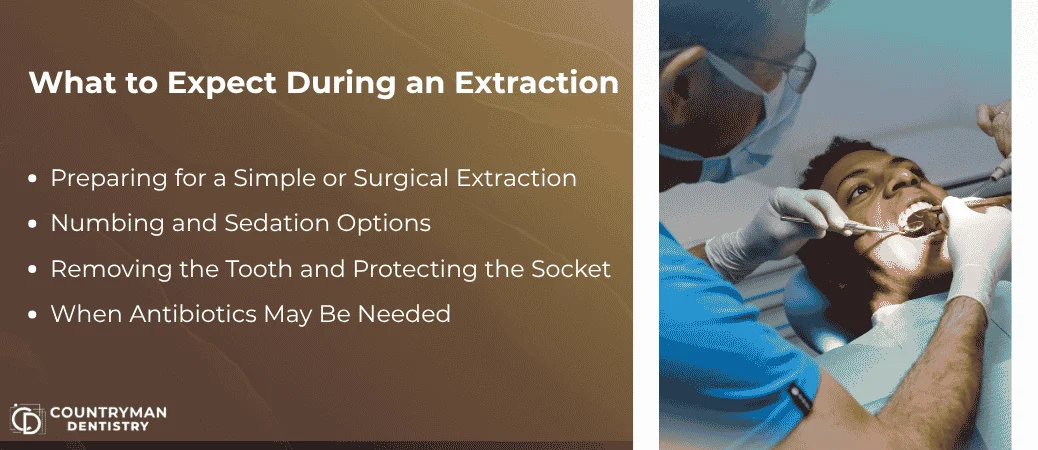
Preparing for a Simple or Surgical Extraction
Before your appointment, your dentist will take an X-ray to check the tooth’s position and the shape of its root.
This helps decide if you need a simple extraction or a surgical extraction. A simple extraction works for teeth you can see above the gum line.
A surgical extraction is needed when a tooth has broken off or hasn’t fully come through the gum. Your dentist will also ask about your medical history and any medicines you take.
You may need to stop eating or drinking for a few hours before the procedure if you’re getting sedation. Wearing comfortable clothes and arranging a ride home is a good idea too.
Numbing and Sedation Options
You won’t feel pain during the extraction because your dentist will numb the area first. Local anesthesia is the most common choice.
It’s injected near the tooth to block pain signals in that specific spot. You’ll stay fully awake, but you shouldn’t feel the tooth being removed.
Some dentists also offer nitrous oxide, often called laughing gas, to help you relax. It wears off quickly once the mask is removed.
For more complex cases, your dentist might suggest oral sedation or IV sedation. This can help if you feel nervous about dental work.
Your dentist will talk with you about which option fits your comfort level and the type of extraction you need.
Removing the Tooth and Protecting the Socket
Once you’re numb, your dentist uses a tool called an elevator to gently loosen the tooth in its socket.
Then forceps are used to rock the tooth back and forth until it comes free. For a surgical extraction, a small cut in the gum may be needed to reach the tooth.
After the tooth is out, your dentist checks the socket for any leftover bone or tissue fragments. They’ll place a gauze pad over the area and ask you to bite down.
This helps a blood clot form, which protects the socket as it heals. You may also get stitches if the extraction was more involved.
Following your dentist’s aftercare steps helps lower your risk of problems and supports healthy healing after tooth loss.
When Antibiotics May Be Needed
Not everyone needs antibiotics after an extraction. Your dentist will decide based on your health and the condition of the tooth before removal.
If you had an active infection, like an abscess, your dentist may prescribe antibiotics before or after the procedure. This helps make sure the infection doesn’t spread to other areas.
People with weaker immune systems or certain heart conditions might also need antibiotics as a precaution. Always take the full course exactly as prescribed, even if you start feeling better.
If your dentist doesn’t mention antibiotics, that usually means your case doesn’t call for them. Ask questions if you’re unsure why you were or weren’t given a prescription.
Healing, Aftercare, and Replacing a Missing Tooth
Taking care of your mouth after an extraction helps you avoid problems and sets you up for a smooth recovery.
Once you heal, you’ll want to think about your options for filling the gap and keeping the rest of your teeth healthy.
Protecting the Blood Clot During Early Healing
Right after your extraction, a blood clot forms in the socket. This clot protects the bone underneath and kick-starts your healing.
You need to be gentle with it for the first few days. Avoid rinsing your mouth hard, using straws, or smoking, since these actions can pull the clot loose.
If the clot comes out too soon, you might end up with a painful problem called dry socket. Stick to soft foods and skip anything crunchy or spicy for a couple of days.
Rinse gently with warm salt water after the first 24 hours to keep the area clean. Your dentist will tell you exactly when it’s safe to go back to normal habits.
Warning Signs That Need Prompt Dental Care

Some discomfort and swelling are normal after an extraction. But certain symptoms mean you should call your dentist right away.
Watch out for:
- Bleeding that won’t stop after a few hours
- Pain that gets worse instead of better after day three
- A bad taste or smell coming from the socket
- Fever or swelling that spreads
- Numbness that lasts longer than expected
These signs could point to infection or dry socket. Catching problems early makes them much easier to treat, so don’t wait if something feels off.
Dental Implants and Implant Placement
A dental implant is often the top choice for replacing a missing tooth because it replaces the root, not just the visible part. This helps keep your jawbone healthy and strong over time.
Implant placement involves putting a small titanium post into your jawbone. Your body needs time to heal around this post before your dentist attaches the new tooth.
In some cases, your dentist might place the implant the same day as your extraction. Other times, you’ll wait a few weeks or months first, especially if you need a bone graft to build up bone before surgery.
Implants function much like natural teeth. You brush and floss them the same way, and they support your chewing function just as well as the tooth they replaced.
Bridges, Partial Dentures, and Other Options
If an implant isn’t right for you, there are other solid ways to replace a missing tooth. A dental bridge uses the teeth next to the gap for support and holds a false tooth in place.
Partial dentures are removable and can replace one tooth or several at once. They tend to cost less upfront than implants or bridges.
Here’s a quick comparison:
| Option | How It Works | Best For |
| Dental Implant | Fuses with jawbone | Long-term stability |
| Dental Bridge | Anchors to nearby teeth | Filling small gaps |
| Partial Denture | Removable device | Budget-friendly, multiple teeth |
Your dentist can help you weigh cost, comfort, and how long each option tends to last.
Protecting Your Remaining Teeth and Jawbone
Leaving a gap unfilled for too long can cause your adjacent teeth to shift out of place. This is one of the consequences of missing teeth that can throw off your bite and make chewing harder over time.
Missing teeth also lead to bone loss in your jaw. Without a tooth root stimulating the bone, that area can shrink and weaken, which affects your jawbone health down the road.
Good oral hygiene habits matter more than ever during this time. Brush twice a day with fluoride toothpaste and floss daily to keep the surrounding teeth and gums healthy.
Regular dental check-ups let your dentist catch any shifting or bone changes early. Staying on top of these visits helps you plan the right timing for tooth replacement and keeps your whole mouth in good shape.
Frequently Asked Questions
Here are some common questions people ask about tooth extractions, from why they happen to how you can care for your mouth afterward.
When is a tooth extraction the only option?
A tooth extraction becomes the only option when a tooth is too damaged to be saved by other treatments like fillings or root canals.
This can happen with severe decay, deep infection, or advanced gum disease that has weakened the bone around the tooth.
Dentists always look at other options first. But when the tooth’s structure is too far gone or the infection has spread, removing the tooth may be the safest choice for your health.
What should I expect during the first 24 hours after a tooth extraction?
Right after your extraction, you’ll bite down on gauze to help a blood clot form in the socket. This clot protects the area and starts the healing process, so try not to disturb it.
You may notice some swelling and mild discomfort during this time. Resting with your head elevated and applying a cold compress can help keep swelling down.
Avoid rinsing, spitting, or using a straw, since these actions can dislodge the clot.
What foods can I eat after a tooth extraction?
Stick to soft foods for the first day or two. Good choices include yogurt, mashed potatoes, applesauce, and scrambled eggs.
As your mouth starts to feel better, you can slowly add in other foods. Just make sure to chew on the side away from the extraction site until it heals more.
What should I avoid after having a tooth pulled?
Skip anything hard, crunchy, or spicy for the first few days. These foods can irritate the extraction site or get stuck in the socket.
You should also avoid smoking, using straws, and drinking alcohol. These habits can raise your risk of problems like dry socket, which happens when the blood clot doesn’t stay in place.
Try to avoid strenuous exercise for a few days too, since it can increase blood flow and lead to more bleeding.
How long does it take for a tooth extraction site to heal?
Most people notice the gum tissue closing up within one to two weeks. But the bone underneath takes longer, often six to twelve weeks to fully heal and remodel.
Your body needs time to build new bone and tissue where the tooth used to be. Following your dentist’s aftercare tips can help this process go more smoothly.
What are my options for replacing a missing tooth after extraction?
Once your mouth has healed, you have a few choices for filling the gap. Dental implants are a common option, since they act like a new tooth root and support a crown on top.
Bridges and dentures are other ways to replace missing teeth. Your dentist can help you figure out which option fits your needs, budget, and how the surrounding teeth and bone are doing.