Waking up with a sore jaw or a dull headache that won’t quit is more common than you might think.
If you catch yourself clenching your teeth during a stressful meeting or grinding at night, you already know how much that tension can take over your day.
Jaw pain and headaches linked to clenching and grinding usually come from overworked muscles, not always from damage inside the joint itself.
That distinction matters because it shapes what kind of treatment actually helps.
Botox for TMJ pain has become a widely used option for reducing the muscle force behind clenching, though it works best as one part of a broader care plan rather than a stand-alone fix.
This article looks at how muscle-driven pain differs from joint problems, how botulinum toxin injections work in the jaw, and what a realistic treatment plan looks like when clenching or grinding is behind your discomfort.
Key Takeaways
- Jaw pain and headaches from clenching or grinding often come from tired, overactive muscles rather than joint damage.
- Botox injections can reduce clenching force and ease muscle tension, but they don’t fix bite problems or joint disease.
- Lasting relief usually combines Botox with night guards, physical therapy, stress management, or specialist care when needed.
Table of Content
- When Clenching and Grinding Point to Muscle-Driven Pain
- How Botox for TMJ Works
- Can Botox Ease Jaw Pain, TMJ Headaches, and Grinding?
- What Else Should Be Part of a TMJ Care Plan?
- Choosing Botox as One Part of Lasting Jaw Pain Relief
- Frequently Asked Questions
When Clenching and Grinding Point to Muscle-Driven Pain
Most jaw pain tied to clenching or grinding comes from muscle fatigue, not from a damaged temporomandibular joint (TMJ).
The jaw muscles, especially the masseter and temporalis, can work overtime during sleep or stressful moments, leading to soreness, tension headaches, and facial pain that feels bigger than it should.
What Is the Difference Between TMJ and TMD?
The temporomandibular joint (TMJ) is the hinge connecting your jawbone to your skull. You have two temporomandibular joints, one on each side of your face.
TMD, or temporomandibular disorder, is the umbrella term for problems affecting that joint or the muscles around it.
Not every case of TMJ disorder involves joint damage. Many involve muscle tension alone.
Symptoms That Often Come From Overworked Jaw Muscles
Overactive jaw muscles tend to cause a specific pattern of symptoms:
- Chronic jaw pain or tightness, especially in the morning
- Jaw stiffness or muscle fatigue after talking or eating
- Difficulty chewing tougher foods
- Facial tension that spreads toward the temples
- Headaches that feel like a tight band around the head
These symptoms often ease with rest, warm compresses, or reducing jaw tension through targeted treatment.
When Jaw Pain May Be Coming From the Joint Instead
Certain TMJ symptoms suggest the joint itself, not just the muscles, needs attention. Jaw locking, clicking paired with swelling, ringing in the ears, or sharp ear pain can point to joint-level issues like disc displacement or early arthritis.
These signs deserve a dental or medical evaluation rather than muscle-focused treatment alone.
How Botox for TMJ Works
Botox for TMJ works by temporarily blocking nerve signals that tell overactive jaw muscles to contract with full force.
Botulinum toxin, the active ingredient in Botox treatment and in Dysport, interrupts the release of acetylcholine, the chemical messenger nerves use to trigger muscle movement.
Less acetylcholine reaching the muscle means less clenching force, which is the main goal of TMJ Botox.

How Botulinum Toxin Reduces Clenching Force
Injected botulinum toxin doesn’t stop the brain from sending the urge to clench. It reduces how strongly the muscle can respond to that signal.
Research and clinical use suggest BTX-A injections into the masseters can reduce bruxism-related pain and biting force, which is why many dentists use it for daytime clenching and nighttime grinding alike.
Which Jaw Muscles Receive Botox Injections
Botox injections for TMJ typically target two muscles:
- Masseter muscle: the main muscle used for biting and chewing, often enlarged in people who grind heavily
- Temporalis muscle: a muscle along the temple that contributes to clenching and tension headaches
A trained provider places small, precise doses into these muscles, usually in a session lasting under 30 minutes.
What Botox Can and Cannot Treat
Botox addresses the muscular component of TMJ disorders rather than structural problems such as disc displacement or joint degeneration.
When structural problems are involved, other treatments may be needed instead of or alongside Botox.

Can Botox Ease Jaw Pain, TMJ Headaches, and Grinding?
Botox can reduce jaw pain, TMJ headaches, and the force behind teeth grinding for many people whose symptoms come from muscle overactivity.
It won’t work the same way for everyone, and results depend on what’s actually causing the pain.
Who May Be a Good Candidate for Treatment
At Countryman Dentistry, Dr. Bryan Countryman can evaluate whether your jaw pain is primarily related to overworked muscles, clenching, grinding, or another TMJ concern.
Botox may be considered when persistent muscle-driven discomfort has not improved enough with conservative approaches such as a night guard or stress management.
When Results Begin and How Long Relief Lasts
Most people notice softening in muscle tension within one to two weeks.
Full effects on clenching force and pain relief tend to build over that same window, with results typically appearing within one to two weeks and lasting three to four months.
After that, muscle activity gradually returns, and repeat treatment may be considered based on your symptoms and response.
What Research and Clinical Experience Can Realistically Show
Clinical studies and real-world use point to meaningful, though not universal, improvement.
Botox is used off-label for TMJ-related symptoms, meaning it isn’t specifically FDA-approved for this purpose, and outcomes vary by patient and provider.
Reported benefits beyond direct jaw pain include:
- Fewer tension headaches and less frequent migraine days for some patients
- Reduced neck pain linked to jaw and facial muscle tension
- Better sleep quality when nighttime grinding decreases
- Less daytime fatigue from constant muscle bracing
Botox doesn’t address every source of head or neck pain, and chronic headaches or migraines can have causes unrelated to the jaw.
A temporary side effect of treatment can include mild muscle weakness in the treated area, which usually resolves as the injection wears off.
What Else Should Be Part of a TMJ Care Plan?
A complete TMJ care plan combines muscle-focused treatment with protective and lifestyle strategies, since clenching and grinding often return once Botox wears off.
Addressing the habit itself, not just its symptoms, produces steadier results over time.
Why Night Guards Still Protect Your Teeth
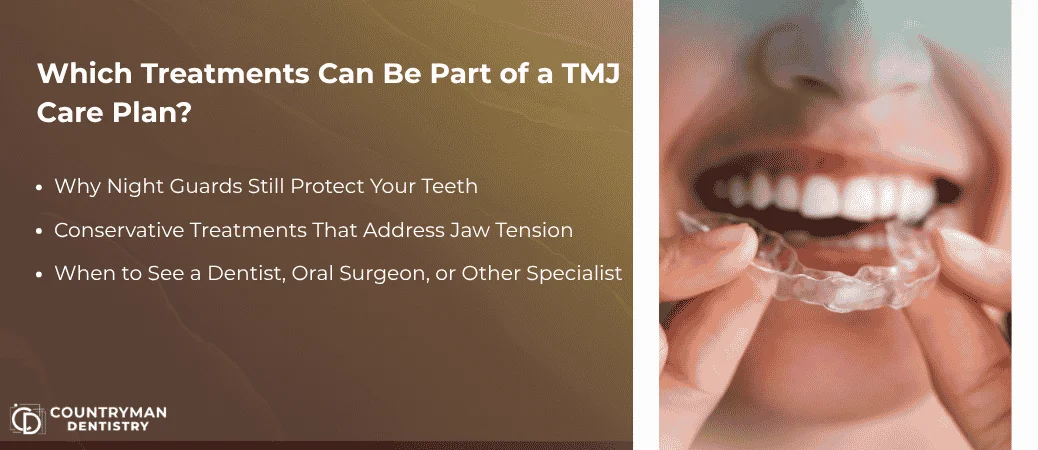
Night guards protect your teeth from wear even if Botox reduces clenching force.
Botox weakens the muscle, but it doesn’t stop the brain signal that causes grinding, so a custom night guard or occlusal splint remains the front line of defense against cracked teeth and worn enamel.
Experienced dentists recommend continuing teeth grinding treatment with a properly fitted mouthguard alongside any Botox sessions.
Conservative Treatments That Address Jaw Tension
Several conservative options work alongside or before Botox:
- Custom night guards or splint therapy to reduce nighttime grinding damage
- Physical therapy or physiotherapy to loosen tight jaw and neck muscles
- Stress management techniques, since stress and anxiety often drive daytime clenching
- Anti-inflammatory medications or muscle relaxants for short-term flare-ups
- Posture correction, since poor posture can add strain to jaw and neck muscles
Antidepressants are sometimes prescribed at low doses for chronic pain management, though this depends on individual evaluation by a dentist or physician.
When to See a Dentist, Oral Surgeon, or Other Specialist
Persistent jaw locking, joint swelling, or pain that doesn’t improve with conservative care calls for a specialist visit.
A dentist can evaluate for splint therapy and refer you to an oral surgeon or ENT specialist if imaging or advanced procedures like steroid injections, arthrocentesis, or TMJ surgery become necessary.
These options address joint-level problems that muscle treatments like Botox cannot fix.
Choosing Botox as One Part of Lasting Jaw Pain Relief
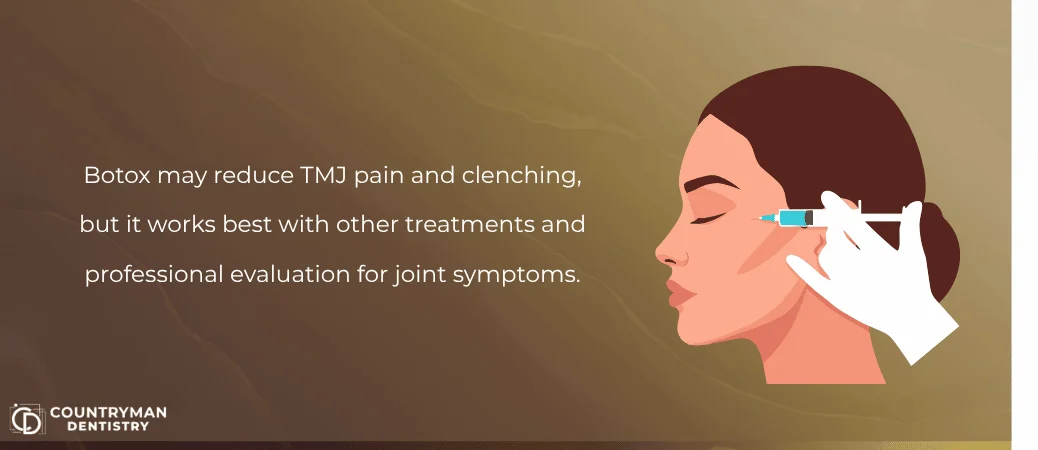
Botox for TMJ works best as one piece of a full jaw pain treatment plan, not a replacement for it.
Reducing muscle force through Botox treatment can bring real relief from chronic jaw pain and clenching, but pairing it with a night guard, stress management, or physical therapy tends to produce steadier, longer-lasting comfort.
If your jaw pain has joint-level symptoms like locking or swelling, a proper TMJ treatment evaluation matters more than injections alone.
Talk with a dentist familiar with Botox for TMJ treatment to figure out where muscle relaxation fits into your specific situation.
Frequently Asked Questions
Does Botox for TMJ stop teeth grinding completely?
Botox reduces the force behind teeth grinding, but it doesn’t stop the underlying urge to clench.
Many patients notice significantly less grinding intensity and pain, though a night guard is still recommended to protect teeth from any remaining movement.
How long does Botox for jaw clenching last?
Relief from Botox injections typically lasts several months before muscle activity gradually returns. Repeat treatment may be considered depending on how long your results last and whether symptoms return.
Can Botox for TMJ help migraines and tension headaches?
Botox may reduce the frequency of tension headaches and some migraines when jaw muscle tension is a contributing factor.
It won’t help headaches caused by unrelated conditions, so a proper evaluation helps confirm whether jaw muscles are actually part of the problem.
What are the risks and side effects of Botox injections for TMJ?
Common side effects include temporary muscle weakness, mild bruising, or soreness at the injection site. An allergic reaction is rare but possible, and choosing an experienced injector lowers the risk of complications like uneven muscle appearance or difficulty chewing.
Should I still wear a night guard after getting Botox for TMJ?
Wearing a night guard after Botox is still recommended, since Botox doesn’t eliminate the brain’s signal to grind.
Night guards protect your teeth from wear and fracture while the muscle relaxation from Botox reduces overall force and discomfort.
When is Botox not the right treatment for TMJ pain?
Botox isn’t the right choice when jaw pain comes from structural joint problems like disc displacement, joint degeneration, or arthritis.
In those cases, a dentist or specialist typically recommends imaging, splint therapy, or other targeted treatments before considering muscle-based injections.